 Muxprotocol
 For Perps Trading And LP Strategies
Muxprotocol routes perpetual trades by composite cost and supports selectable market exposure through native liquidity pools. Trading collateral supports a leveraged position; LP capital backs the pools that take the opposite side of trades. The aggregator fits execution that needs cost-based routing or pooled capacity. Elemental pools, portfolio pools, and the market-neutral vault serve different liquidity and yield tasks. Their outcomes differ: an open position, a pool share, or participation in a vault strategy. A contributor response dated May 16, 2026 described MUX as operating in maintenance mode. Access restrictions exclude US Persons and Restricted Persons.
Perps Execution Through Aggregated Liquidity
Cost-based routing fits positions that need available capacity from compatible sources across integrated perpetuals protocols. A source must support the selected market and have sufficient available liquidity for its allocation. MUX can keep a position in one source or split it across several, with user preferences also affecting selection. An integration expands the possible routes without promising capacity for every market and position size. After execution, check the opened position's size, margin requirements, and charges.
Composite trading cost considers execution pricing, spread, slippage, price impact, and position fees, alongside margin requirements and liquidation charges. A low advertised position fee alone cannot describe that combination. In the MUX V1 trading model, ETH and BTC trades have 0% spread and price impact. Those execution terms leave position fees and ongoing charges as separate costs. Aggregation has more scope to improve execution when several sources can serve the intended trade. That scope narrows when market support or user preferences leave only one eligible source.
Additional Leverage And the Margin Commitment
Leverage boosting can support a routed position beyond the underlying protocol's native opening leverage limit. The aggregator supplies additional margin from the MUX universal liquidity pool. Those assets back the underlying position and can improve its liquidation price under MUX's applicable maintenance-margin rule. The arrangement can provide leverage up to 100x where the applicable market and route support it. A quoted maximum does not establish the same opening capacity for every position.
Boosting carries opening and closing charges based on the additional margin supplied. Boost funding charges can also apply while a position remains open. These costs sit alongside the underlying protocol's charges. V3 supports cross margin and isolated margin modes, which address margin organization separately from the requested leverage. A route's maintenance requirement remains relevant throughout the position's life.
Any residual margin after boosted-position liquidation returns only after the applicable underlying liquidation charge and boost fee deductions.
Selecting a V3 Pool by Market Exposure
V3 elemental pools fit liquidity provision that requires control over collateral, supported markets, and directional exposure. LPs buy MUX3LP shares with the chosen pool's supported collateral token. Each pool uses one collateral asset and supports its configured market exposures, while P2Multi-Pool connects traders with suitable pools. Several pools can support the same market direction, and one pool can support several markets. The collateral token and the market being traded therefore describe different parts of the arrangement.
MUX3LP Share Accounting
Trading Fees In The Share Price
Trading fees accrue through the MUX3LP share price, so holders do not need a separate fee claim. This accounting differs from V1 MUXLP staking distributions.
Trader Outcomes And Collateral Prices
Traders' profits and losses affect the value of MUX3LP shares. The collateral token's price also affects that value. Fee income does not isolate an LP from losses on the pool's trading exposures or collateral. Stablecoin collateral likewise leaves the pool's role as a trading counterparty intact.
Can Portfolio Pools Automate Allocation Across V3 Pools?
V3 portfolio pools automate rebalancing across MUX3LP holdings toward specified target weights. LPs can buy the component MUX3LP tokens and then supply them to the portfolio pool, which supplies those holdings to Balancer V3. This fits maintaining an allocation across several pools. A single elemental pool fits a task that requires one pool's specific collateral and directional exposure. Rebalancing changes allocation across holdings; it does not remove the risks of the underlying pools or provide a fixed yield.
Yield-Bearing Assets in the Market-Neutral Vault
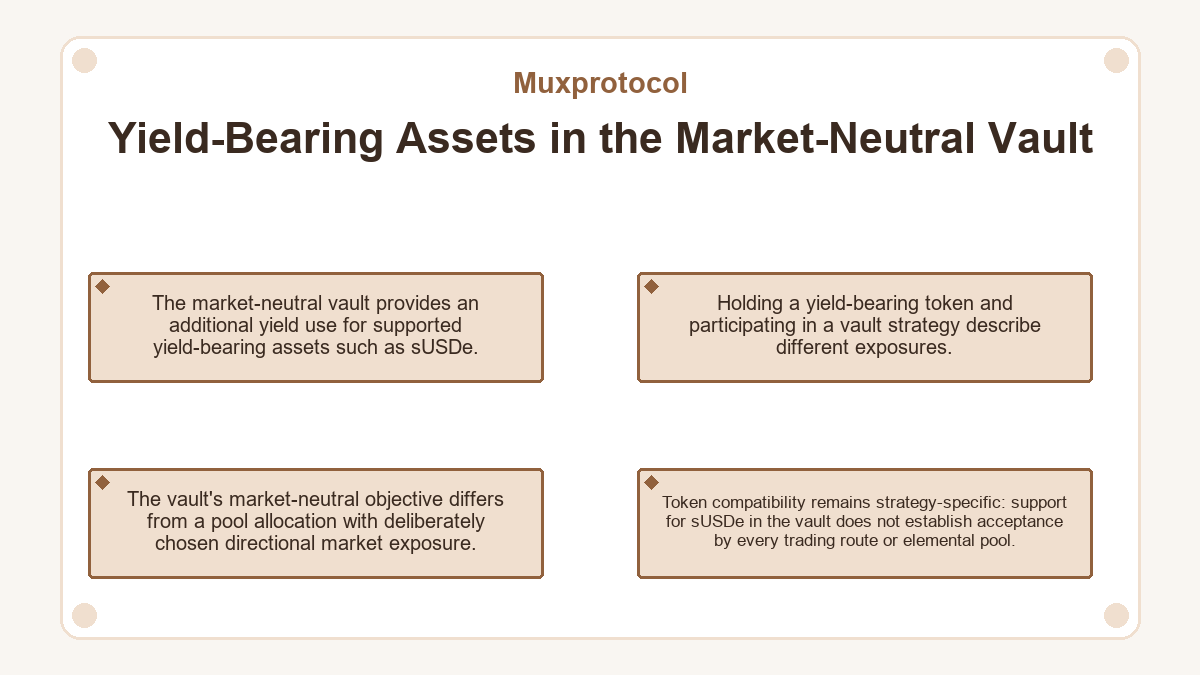
The market-neutral vault provides an additional yield use for supported yield-bearing assets such as sUSDe. Holding a yield-bearing token and participating in a vault strategy describe different exposures. The vault's market-neutral objective differs from a pool allocation with deliberately chosen directional market exposure. Token compatibility remains strategy-specific: support for sUSDe in the vault does not establish acceptance by every trading route or elemental pool.
V1 Pool Participation And Governance Income
V1 MUXLP provides participation in a shared, multi-asset trading pool and access to its staking income stream. A filled buy order mints MUXLP in exchange for an allowed pool asset; a filled sale burns the tokens. Holding the token and staking it represent distinct states. MUXLP staking and reward distribution take place only on Arbitrum. A purchase on another supported network therefore does not itself create an Arbitrum staking balance.
Locking MCB or MUX creates veMUX and is available only on Arbitrum. veMUX carries governance weight and access to protocol income and MUX rewards. The documented lock range runs from two weeks to four years. For the same token amount, longer locks create more initial veMUX, whose balance then declines as expiry approaches. Locked MCB or MUX cannot be withdrawn before expiry; MUXLP staking uses the shares that represent supplied pool liquidity.
MUXLP remains exposed to its underlying assets and the pool's positions against traders, including losses from profitable trader positions.
Trading And LP Choices by Intended Exposure
The selected component determines whether capital supports a trader's leveraged exposure or a liquidity-provider strategy.
| Component | Supported Use And Material Constraint |
|---|---|
| Perpetual Aggregator | Directional perps execution across eligible sources; market support and available liquidity constrain the route. |
| MUX V3 Elemental Pool | Selected collateral and market exposure; trader outcomes and collateral prices can reduce share value. |
| MUX V3 Portfolio Pool | Automatic rebalancing across MUX3LP holdings; exposure follows the underlying holdings and their target weights. |
| MUX V1 MUXLP | Multi-asset pool participation; staking income requires an Arbitrum staking position. |
| Market-Neutral Vault | Additional yield from supported yield-bearing tokens, including sUSDe. |
Long-tail trading also has MUX V1 Degen, which uses the separate DegenLP pool. That stablecoin-only pool restricts liquidity supply to whitelisted sophisticated traders and LPs. A long-tail trading route and permission to supply its liquidity are separate forms of access.
Access Restrictions And Maintenance Constraints
Eligibility and operating status constrain each use case before trading or liquidity participation begins. MUX excludes US Persons and Restricted Persons from its services. The Terms and Conditions, last modified September 7, 2023, also prohibit bypassing restrictions with VPNs or other anonymization tools. A wallet connection establishes neither eligibility nor an exemption from these restrictions.
Jean's May 16, 2026 governance response described regular bug fixes while MUX operated in maintenance mode. The response favored continued operation after a community wind-down proposal. It did not announce a completed shutdown. If MUX does not support the required market or integration, the trader needs a venue that does.
Muxprotocol FAQs
Does 1-Click Trading Cover Changes to Existing Positions?
MUX's 1-Click Trading supports opening, closing, and managing positions without signing each transaction. Liquidity, margin requirements, and fees continue to govern the positions being managed. Reduced signing does not change the position's underlying market exposure.
Can a MUX V1 Trade Pay Profits in a Different Token From Its Collateral?
MUX V1 can settle profits in a token different from the posted collateral. Long profits normally settle in the underlying asset; short profits settle in stablecoins. Longs also settle in stablecoins when the underlying asset is absent from that network. If local reserves are insufficient, settlement can include muxTokens, redeemable on another network with sufficient reserves or locally after reserves refill. These differ from the MUX reward token.
How Long Does Vesting LP-earned MUX Into MCB Take?
Once vesting starts, the non-transferable MUX reward token converts linearly into MCB over one year on Arbitrum. Eligibility uses either a quota linked to veMUX or capacity linked to reserved, staked MUXLP. Conversion progresses through the vesting period; earning MUX does not make the whole amount immediately available as MCB.
Do I Need an MCB Lock Before Supplying Native Liquidity?
V1 MUXLP and V3 elemental-pool participation use accepted pool assets and do not require an MCB lock. MUX V1 accepts assets allowed by the MUXLP portfolio, while a V3 elemental pool takes its supported collateral token. Locking MCB creates veMUX for governance and income participation, a different commitment from supplying liquidity.
Which MUX V1 Order Can Target a Long Entry Above the Current Price?
A MUX V1 trigger buy uses a mark-price condition at or above the specified trigger. A limit buy uses a mark price at or below its limit. These conditions address different entry intentions. An open conditional order remains unfilled until its execution conditions permit a fill.