 Muxprotocol
 Aggregated Perpetuals And Native Liquidity Pools
Muxprotocol combines perpetual futures aggregation with native liquidity pools for leveraged crypto trading and liquidity provision. Perpetual futures give long or short market exposure without a fixed expiry. Its MUX router can direct one position across suitable liquidity sources, while native pools supply the assets that support trading. V3 liquidity providers can choose pools by collateral asset, market, and long or short exposure. A May 2026 governance response described the protocol as operating in maintenance mode, with continuing bug fixes.
In short: Zero price impact on native BTC and ETH trades does not remove position fees or ongoing financing charges.
The Aggregator And Its Native Trading Protocols
The MUX Perpetual Aggregator connects the trading interface to integrated perpetuals protocols, including MUX's native trading systems. MUX V3 uses elemental pools through its P2Multi-Pool architecture. MUX V1 draws liquidity from the multi-asset MUXLP pool, while the V1 Degen protocol uses a separate DegenLP pool for long-tail markets. The aggregator also integrates external protocols, including GMX V1, GMX V2, and gTrade. Integration identifies a possible liquidity source; market support and available capacity determine whether that source can serve a particular position.
On the native V1 system, the pool reserves assets against trader exposure until closure. A profitable position draws on reserved assets; a losing position uses the trader's collateral to settle losses. The trader's collateral deposit and the liquidity provider's pool share represent different claims.
Maintenance Mode And Released Features
Maintenance mode is the operating posture that Jean described in a May 16, 2026 governance response. The response said MUX continued running while contributors addressed bugs. A community wind-down proposal prompted that discussion; the response described continued operation rather than a completed shutdown.
MUX contributors' September 3, 2025 budget proposal reported the release of V3 portfolio pools, neutral mining, one-click trading, and cross margin. One-click trading removes repeated transaction-signing prompts for supported position actions. It covers opening, closing, and managing positions.
How Does MUX Select a Trading Route?
MUX selects one or more eligible liquidity sources using the market, position size, available liquidity, composite trading cost, and user preferences. A source must offer the requested market and sufficient capacity for its share of the position. The router can split an aggregated position across multiple sources when that arrangement supports the requested exposure.
Composite cost considers execution price and explicit charges alongside leverage and maintenance-margin constraints. Opening fees, ongoing financing, and liquidation conditions can differ between sources. Routing compares those conditions for the requested position.
Collateral, Margin Modes, And Position Containers
Collateral backs trading exposure, while margin modes and position-holding contracts govern different aspects of a position's organization.
Trading Collateral
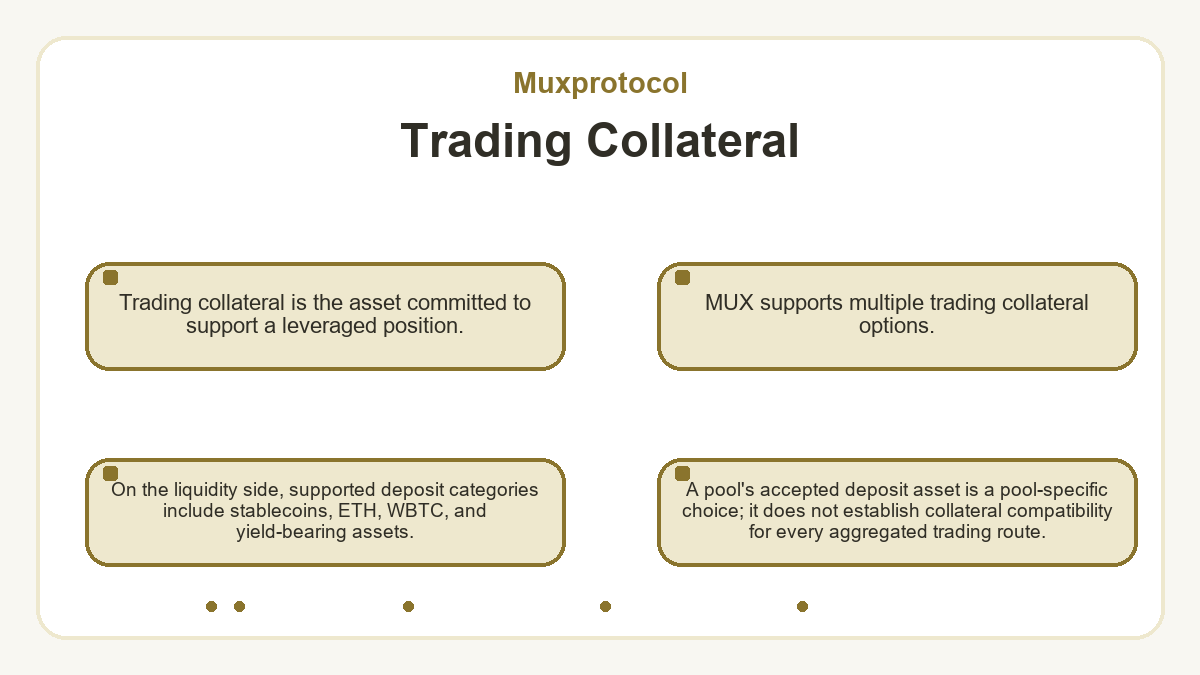
Trading collateral is the asset committed to support a leveraged position. MUX supports multiple trading collateral options. On the liquidity side, supported deposit categories include stablecoins, ETH, WBTC, and yield-bearing assets. A pool's accepted deposit asset is a pool-specific choice; it does not establish collateral compatibility for every aggregated trading route.
Isolated And Cross Margin
MUX V3 supports isolated and cross margin as distinct trading modes. Isolated margin assigns collateral to an individual position; cross margin shares collateral within its account arrangement. A source reached through aggregation has its own applicable margin requirements. The selected trading setup determines which arrangement applies.
Position Containers
The aggregator's position containers are smart contracts that hold positions on underlying protocols for traders. The underlying protocol sees the container contract as its direct user. This contract-level role differs from the trader's wallet identity and from the pool that supplies liquidity.
Leverage Boosting And Liquidation Exposure
Leverage boosting supplements the collateral supplied to a supported underlying position, allowing higher leverage or a different liquidation-price arrangement.
Initial margin governs opening a position; maintenance margin governs keeping it open. MUX can supply additional margin from its universal liquidity pool to a position on an aggregated protocol. The trader-facing liquidation threshold in a boosted arrangement can differ from the underlying venue's threshold.
The trader's deposit and the pool-supplied margin remain separate amounts. Boost fees apply to that supplied margin, and boost funding can add an ongoing charge.
Boosted positions have their own applicable maintenance threshold. When remaining margin falls below that threshold, the aggregator liquidates the position and closes the corresponding underlying exposure. Settlement returns any remaining trader margin after the applicable liquidation and boost charges.
The advertised ceiling is up to 100x leverage. Actual availability depends on the supported market, liquidity source, margin arrangement, and position.
Does Zero Price Impact Mean Fee-Free Trading?
Zero price impact leaves position fees and ongoing financing charges to pay. The zero-spread claim specifically covers BTC and ETH on the native pool, rather than every market reached through aggregation.
Native Position And Borrowing Charges
The native MUX V1 and V3 fee schedule sets each opening or closing fee at 0.06% of position notional. Notional means asset price multiplied by position size. The fee therefore applies to market exposure, rather than only the collateral deposit. V3 borrowing charges also reflect pooled-asset utilization and the direction of the position. A position that remains open can accumulate financing costs after its opening fee.
Aggregated And Degen Costs
A third-party position reached through aggregation follows the underlying protocol's charges, with additional boost charges where leverage boosting applies. Degen uses dynamic price impact and a separate position-fee schedule. Its pricing mechanics differ from the zero-impact native markets. A fee estimate needs the actual trading protocol and applicable features to identify which charges belong to the position.
Oracle Pricing And Network-Level Liquidity
Oracle-based pricing supplies native execution prices from aggregated price feeds. MUX V3 uses Chainlink Data Streams and the MUX Dark Oracle. In V1's universal-liquidity system, a broker accounts for available pool assets across deployed networks without moving those assets for every trade. Global depth and local settlement reserves remain different quantities. If the selected chain lacks sufficient tokens for V1 profit settlement, part of the payout can take the form of muxTokens redeemable on another supported network with sufficient reserves. These settlement claims differ from MUX reward tokens.
Trading Routes And Liquidity Options
A perpetual position creates directional market exposure, while an LP share creates exposure to pool assets and trading results. Native pools supply counterparties for trading; the aggregator extends the set of possible liquidity sources.
| Trading Or LP Option | Liquidity Basis And Exposure |
|---|---|
| Aggregated perpetual position | Eligible integrated sources; a position can span multiple sources. |
| Native V3 position | Elemental pools, with isolated and cross margin modes. |
| Native V1 position | MUXLP liquidity; zero spread applies to native BTC and ETH markets. |
| V1 Degen position | Separate DegenLP liquidity and dynamic price impact for long-tail markets. |
| MUX3LP pool share | Individual V3 pool with its supported collateral and selected exposures. |
| MUXLP pool share | Multi-asset V1 portfolio with exposure to pooled assets and trading outcomes. |
| Market-neutral vault | Additional-yield strategy for supported yield-bearing assets, including sUSDe. |
Pool Shares, Portfolio Pools, And Market-Neutral Vaults
Native liquidity provision links fee income to the exposure of the selected pool or strategy.
Elemental And Multi-Asset Pool Shares
MUX3LP represents liquidity in an individual V3 elemental pool. Fees accrue through its token price, alongside changes caused by trader profit and loss and the collateral asset's price. MUX V3 elemental pools act as counterparties to traders. Fee income can therefore coexist with losses on the pool's exposure.
MUXLP tracks the value of the multi-asset V1 pool per token. Its separate staking mechanism provides access to the associated protocol-income allocation.
Portfolio Rebalancing
Portfolio pools combine MUX3LP holdings and rebalance toward target weights. Rebalancing changes the allocation among pool shares; those holdings retain the collateral and trading exposures of their underlying pools.
Market-Neutral Vaults
The market-neutral vault provides an additional-yield route for supported yield-bearing assets, with sUSDe among the stated examples. The vault targets neutral market exposure, while an elemental pool can support a selected market side. The deposited asset and the strategy applied to it remain separate parts of that exposure.
Governance Tokens And Protocol Income
MCB, MUX, and veMUX perform different roles in the protocol's token system. MCB is the main token. MUX is the reward token, while veMUX supplies governance weight through locked MCB or MUX. The locking arrangement weights the balance by time, so governance weight declines as the lock approaches expiry. These governance and reward rights differ from the liquidity exposure represented by MUXLP or MUX3LP.
Protocol income follows separate recipient categories. V3 income allocations include MUX3LP holders; V1 allocations include MUXLP stakers. veMUX holders receive their allocated share, and the protocol-owned liquidity ratio affects the external LP share. Aggregator referral rebates from integrated protocols have their own allocation to veMUX holders.
Eligibility And Direct-Venue Alternatives
MUX excludes US Persons and Restricted Persons from its features and services. Those restrictions apply alongside product-specific collateral and liquidity requirements. Among eligible trading routes, direct use of one integrated protocol leaves venue selection with the trader. Aggregated trading delegates that selection to the router and can distribute a position across several liquidity sources. Native pool participation creates a separate choice: a perpetual position takes market exposure, while an LP share takes exposure to the pool supporting that market.
Muxprotocol: reader questions
Do I Need to Stake MUXLP on Arbitrum to Receive Staking Rewards?
MUXLP staking and its reward distribution take place on Arbitrum. Holding MUXLP on another supported network does not activate Arbitrum staking. The tokens must be available on Arbitrum for that staking arrangement; buying MUXLP and staking it are separate operations.
Are MUX and veMUX Transferable Between Wallets?
MUX and veMUX are non-transferable tokens available on Arbitrum. MUX is a reward token with locking and vesting uses, while veMUX represents governance weight from locked MCB or MUX. Neither token supports an ordinary wallet-to-wallet transfer.
Can I Cancel a MUXLP Order Before It Fills?
A pending MUXLP buy or sell order can be cancelled before processing. Cancelling a buy order returns the payment tokens; cancelling a sell order returns the MUXLP tokens. An order that has already filled is outside this cancellation path.
Where Can I Disable an Aggregated Liquidity Source?
The aggregator's trading settings let traders turn available liquidity sources on or off. A disabled source will not receive routed positions under that selection. The remaining sources still need to support the requested market and position size.
Is DegenLP Liquidity Supply Open to Everyone?
DegenLP liquidity supply is limited to whitelisted participants because of the pool's higher-risk exposure. The pool supports the separate MUX V1 Degen protocol. Access to another MUX trading feature or liquidity pool does not establish eligibility to supply DegenLP liquidity.
What Changes MUXLP Buying and Selling Fees?
MUXLP buying and selling fees respond to each portfolio asset's weight relative to its target. An asset below target attracts a lower buying fee and a higher selling fee. Above target, the direction reverses. The fee therefore depends on the asset used and the pool's composition when pricing the order.
Which Network Should My Wallet Use for a Trade?
The wallet network must match the network selected for the trade in MUX. A mismatch produces a "Wrong Network" state in the trading interface.