 Muxprotocol
 position routing allocates perpetual trades across suitable liquidity sources
Muxprotocol position routing selects one or more liquidity sources using market compatibility, available capacity, position size, composite trading cost, and user preferences. A single source can support an entire position when its capacity permits. Splitting lets the MUX Perpetual Aggregator combine suitable sources for larger positions or a lower estimated overall cost.
A split changes where the position's components sit and which underlying conditions apply. Understanding the allocation requires separating capacity from pricing, then connecting each component to its margin requirements and charges. An opening request alone does not establish the resulting position.
Key takeaway: Disabling a liquidity source removes it from routing, which can change both available position capacity and estimated trading cost.
Single-Source Capacity and Split Orders
A position can use one source when that source supports the requested market and offers enough available liquidity. The router also evaluates composite cost. Having sufficient capacity makes a route possible; another allocation can offer a lower estimated cost. Conversely, the lowest-cost source cannot support an allocation beyond its available capacity.
Split orders distribute a position across compatible liquidity sources when the selected allocation requires several components. MUX supports managing those components as an aggregated position. Total protocol liquidity and capacity available for a particular trade describe different quantities. Liquidity serving another market or direction does not automatically support the requested position. The relevant amount is the capacity that compatible sources can allocate to that trade.
Market, Direction, and Enabled Sources
Market support and user preferences bound the router's choices among compatible sources for a particular position. MUX integrates MUX V3, MUX V1, and MUX V1 Degen alongside GMX V1, GMX V2, and gTrade. Disabling a source excludes it from allocation. Each remaining source needs capacity for the requested market and direction. Liquidity supporting an ETH long does not establish ETH-short capacity. Reducing the enabled source set can increase estimated cost or leave insufficient capacity.
How Does MUX Compare Routing Costs?
MUX compares composite trading costs across suitable liquidity sources, including pricing effects, explicit charges, and margin-related conditions that affect the position. The aggregator's composite-cost assessment includes price, spread, slippage, price impact, and position fees. The assessment also considers leverage limits, maintenance margin, liquidation fees, and available liquidity. A small position-fee percentage therefore describes only part of the comparison. Position size can change which allocation offers the lowest estimated cost while satisfying the capacity requirement. Splitting may improve cost, expand usable capacity, or serve both purposes.
The router allocates components using the estimated costs that suitable sources offer. Cost and capacity inputs shape the allocation proportions; splitting does not imply equal shares across protocols.
A Split Position From Capacity to Execution
This hypothetical ETH-long example uses invented USD position notionals, available capacities, and executed allocations. Both enabled sources support the market, and the account meets their applicable margin and fee requirements. The first source has $51,620 available for this direction; the second has $43,105. Their combined capacity is $94,725.
A requested position notional of $49,872 fits within the first source's capacity, making a single-source allocation possible. Increasing the request to $82,472 changes that boundary. Neither source can support the larger request alone, although their combined capacity exceeds it. Execution across these two sources therefore requires a split.
The trader submits the larger opening request. Submission identifies the requested action; the account has reached the intended state only when the corresponding position opens. This comparison concerns position notional at execution, separate from collateral deposited or fees charged.
Assume execution opens $51,620 on the first source. The remaining allocation is $82,472 - $51,620 = $30,852 on the second. That amount fits within its $43,105 capacity. The executed components total $82,472, matching the requested position notional.
Before continuing, the trader reconciles the opened components with that requested amount and their associated charges. A submission identifier alone cannot establish this match. If usable capacity changes before execution, the earlier capacity calculation no longer establishes that the same allocation remains feasible.
Aggregated Pricing and Position Containers
Underlying entry prices can differ across protocols, which complicates presenting several components as one position with unified pricing. The aggregator can absorb underlying pricing differences within a bounded range.
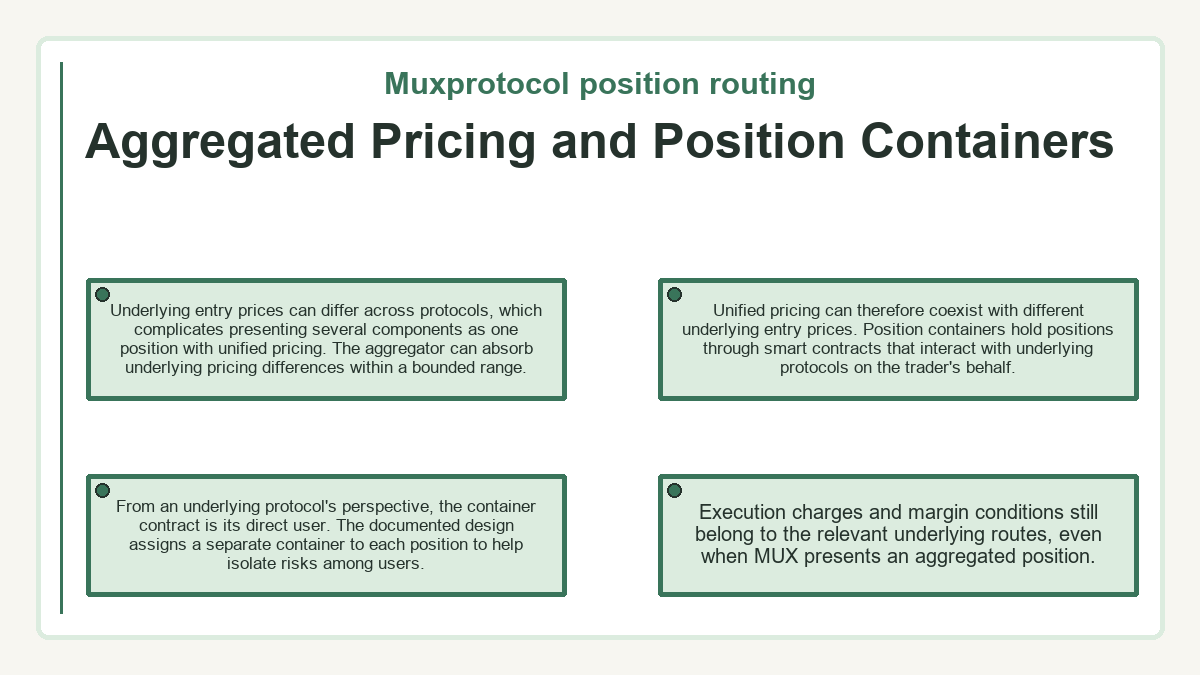
Unified pricing can therefore coexist with different underlying entry prices. Position containers hold positions through smart contracts that interact with underlying protocols on the trader's behalf. From an underlying protocol's perspective, the container contract is its direct user. The documented design assigns a separate container to each position to help isolate risks among users. Execution charges and margin conditions still belong to the relevant underlying routes, even when MUX presents an aggregated position.
Native V3 Pool Routing
MUX V3 routes traders' positions through its P2Multi-Pool architecture, where elemental pools provide liquidity with selectable collateral and market exposures. One position can draw support from several elemental pools. Multiple pools can supply the same market direction using different collateral assets, and one pool can support multiple trading pairs. This allocation among native pools complements the aggregator's allocation across integrated protocols.
Boost Margin and the Fee Base
Leverage boosting changes a routed position's margin arrangement when MUX supplies additional margin on an underlying trading protocol. The mechanism can increase available leverage and adjust the liquidation threshold.
The leverage boost fee uses the additional margin supplied by MUX as its calculation base.
For a boosted component whose MUX maintenance-margin rate is lower than the underlying rate, calculate supplied boost margin using that component's notional:
(MM - MM2) * position notional
. Here,
MM
is the underlying maintenance-margin rate, and
MM2
is the MUX rate for the mechanism. Multiplying that boost margin by the applicable boost fee rate gives the boost fee. Rates must use consistent fractional units. A rate on boost margin cannot be applied directly to the entire position notional without changing the calculation.
Opening and closing charges can include both the underlying protocol's position fee and a separate boost fee. Different calculation bases keep those charges distinct even when they arise from the same position.
Can a Cheaper Route Change Liquidation Exposure?
A route with lower estimated trading cost can have different liquidation conditions because underlying protocols use different margin requirements. Maximum opening leverage and maintenance requirements affect different boundaries. The former constrains entry; the latter determines how much remaining margin supports an existing position. MUX's additional margin can alter those conditions for a boosted position.
For the documented boost mechanism, liquidation occurs when remaining margin falls below the applicable MUX maintenance requirement. MUX also closes the corresponding underlying position. Any residual margin returns after the applicable underlying liquidation charge and boost fee deductions. An improved liquidation price does not remove this threshold.
Funding Timing and Collateral Deductions
Boost funding is a separate charge from funding levied by an underlying protocol, and the documented mechanism deducts both from trading collateral. Its calculation uses supplied boost margin multiplied by the applicable funding rate. The same distinction between boost margin and total position notional therefore matters for ongoing costs.
The documented boost mechanism collects boost funding hourly. At collection, it rounds an open period shorter than one hour up to one hour. If the position closes before the next collection, it charges no boost funding for that uncollected interval. This exception concerns boost funding; underlying funding and position charges retain their own applicable conditions. Holding duration alone does not determine the total cost without the collection boundary and relevant rates.
Route Availability and Operating Constraints
US Persons and Restricted Persons cannot access MUX trading features and services, regardless of whether a suitable liquidity allocation exists. Market availability also belongs to a specific protocol route. Planned integrations add no executable capacity until they become available.
In a May 16, 2026 governance response, Jean described MUX as operating in maintenance mode, with regular bug fixes and efforts to reduce operating costs. The reply followed a community wind-down proposal; it described continued operation amid weak trading volume and fees.
The available routes and their estimated costs can change when a source no longer supports the market, usable capacity changes, user preferences exclude a source, or applicable cost and margin parameters change.
Muxprotocol position routing FAQ
Do Position Containers Hide the Wallet Behind a Routed Trade?
Position containers do not make the trader's wallet identity secret. The aggregator design includes an API for querying trader addresses behind their containers. The underlying protocol treats the container contract as its direct user, while the mapping can identify the trader.
Is Every Aggregated Route Free of Spread and Price Impact?
MUX specifies zero spread and price impact for native BTC and ETH trading, while its V3 description covers blue-chip markets. The aggregator also evaluates other sources with their own pricing conditions. An allocation to an external protocol does not inherit the native-market claim. Position fees and other applicable charges remain separate from spread and price impact.
Can a V1 Profit Payout Require Redemption on Another Chain?
A V1 profit payout can include asset-specific muxTokens when the local pool cannot cover all profits in underlying assets. The trader can bridge those claim tokens and redeem corresponding assets on another chain with available liquidity. This branch concerns the uncovered profit portion. These muxTokens differ from the protocol's non-transferable MUX reward token.
How Soon Can a Pending V1 Position Order Be Cancelled?
The V1 order-book implementation requires its configured cancellation cooldown to elapse before cancelling a pending position order. For non-broker callers, permission rests with the account owner or a trusted aggregator. Brokers must also wait beyond the order's deadline. The duration depends on the order type and configured timing parameters.
Which Oracle Inputs Support V3 Native Position Pricing?
MUX V3 combines Chainlink Data Streams with the MUX Dark Oracle for price aggregation. V1 separately uses a private oracle that aggregates exchange feeds, with its broker obtaining the execution price when filling native orders.
Are V1 Degen Positions Backed by the Standard MUXLP Pool?
MUX V1 Degen positions use the separate DegenLP pool. The standard V1 Trading Protocol uses MUXLP, while V3 uses elemental pools. A market's appearance through the aggregator therefore does not identify its backing pool. The protocol version receiving the allocation determines the liquidity structure that supports that part of the position.
Does a Split Allocation Move Pooled Assets Between Chains?
A split identifies an allocation across liquidity sources and does not by itself establish a cross-chain asset transfer. V1 universal liquidity is a separate mechanism: its broker calculates pooled capacity across deployed networks without moving pooled assets between them.